


What Are You Reading 4
- Thread starter Tonyblack
- Start date
Welcome to the Sir Terry Pratchett Forums
Register here for the Sir Terry Pratchett forum and message boards.
Sign up

So, right now I'm reading "The Black-eyed Blonde" by John Banville, which is a fairly good Philip Marlowe mystery. 
No one can do Philip Marlowe like Raymond Chandler but Banville does a credible job. His Marlowe is older, slower, more flawed and more tolerant than Chandler's. He's also more vulnerable to being seduced, but still a knight in sour armor.
I dislike the call-backs to Chandler books, especially The Long Good-bye. It shows that Banville is a little bit afraid of writing Marlowe without telling us about Terry Lennox and his gimlets, a cocktail he invented in the book: half gin and half lime juice over crushed ice, and nothing else. For anyone who hasn't read The Long Good-bye, this might be necessary. But for anyone who has read it (and let's face it, what kind of Raymond Chandler fan are you if you haven't?), it's irritating.
Haven't finished yet (just about), but I'll give it three-and-a-half stars. It'd be higher if it wasn't for all those call-backs to The Long Good-bye.
No one can do Philip Marlowe like Raymond Chandler but Banville does a credible job. His Marlowe is older, slower, more flawed and more tolerant than Chandler's. He's also more vulnerable to being seduced, but still a knight in sour armor.
I dislike the call-backs to Chandler books, especially The Long Good-bye. It shows that Banville is a little bit afraid of writing Marlowe without telling us about Terry Lennox and his gimlets, a cocktail he invented in the book: half gin and half lime juice over crushed ice, and nothing else. For anyone who hasn't read The Long Good-bye, this might be necessary. But for anyone who has read it (and let's face it, what kind of Raymond Chandler fan are you if you haven't?), it's irritating.
Haven't finished yet (just about), but I'll give it three-and-a-half stars. It'd be higher if it wasn't for all those call-backs to The Long Good-bye.
Likes:
SpideyGirl and Tonyblack
Done with "The Black-eyed Blonde", and my opinion hasn't changed: it's a fairly good Marlowe mystery, but can't compare to Ray Chandler. ;-p
I've just started reading Hercule Poirot's Silent Night, by Sophie Hannah -- an author who was authorised (sorry) by the Christie Estate to write new Poirot novels.
Unfortunately, I can't find much to recommend here. I've gone through the first six chapters, and so far, I am finding this book utterly tedious and baffling. Inspector Catchpool (Hannah's equivalent of Captain Hastings) is a non-entity whose sole duty is to be tortured by his domineering mother -- really, for a Scotland Yard Inspector, he seems positively stupid -- and Poirot does not show either his usual eccentricity or energy.
The pacing is also incredibly slow. One of the characters is about to give Poirot the two 'leads' that he thought of, only to start complaining about how education in this country has gone downhill, and how Inspector Mackle of the local police is following up the wrong suspects, and so on and so forth. It drove me to distraction, and made me want to bang my head on the table and shout "Get on with it!!!" ... and then, just as things started moving, the suspect's wife entered and muttered something about how she's giving up on him and went away, and Poirot abandoned the idea of the "two leads" and went off after her.
If I hadn't paid for this book, I would seriously consider throwing it into the fire. It doesn't seem worth it.
Have you read Sophie Hannah's Poirot books? What did you think?
I've just started reading Hercule Poirot's Silent Night, by Sophie Hannah -- an author who was authorised (sorry) by the Christie Estate to write new Poirot novels.
Unfortunately, I can't find much to recommend here. I've gone through the first six chapters, and so far, I am finding this book utterly tedious and baffling. Inspector Catchpool (Hannah's equivalent of Captain Hastings) is a non-entity whose sole duty is to be tortured by his domineering mother -- really, for a Scotland Yard Inspector, he seems positively stupid -- and Poirot does not show either his usual eccentricity or energy.
The pacing is also incredibly slow. One of the characters is about to give Poirot the two 'leads' that he thought of, only to start complaining about how education in this country has gone downhill, and how Inspector Mackle of the local police is following up the wrong suspects, and so on and so forth. It drove me to distraction, and made me want to bang my head on the table and shout "Get on with it!!!" ... and then, just as things started moving, the suspect's wife entered and muttered something about how she's giving up on him and went away, and Poirot abandoned the idea of the "two leads" and went off after her.
If I hadn't paid for this book, I would seriously consider throwing it into the fire. It doesn't seem worth it.
Have you read Sophie Hannah's Poirot books? What did you think?

So, I've decided to ditch my review blog system, possibly for good, for various reasons. So, I'll be commenting on books here. I'll probably be discussing graphic novels and manga more than full-on books for the most part. Then again, I have one hell of a backlog of those...
My latest book is the second graphic novel adaptation of Artemis Fowl and the Arctic Incident. On the one hand, it's not a bad adaptation, and the character designs in many ways are truer to the books. On the other hand, as with Michael Moreci and Stephen Gilpin's adaptation of the first book, the art style is more childish and scribbly, and they leave out a few key plot points, including one vital one during the rescue of Artemis Fowl Senior.
While the previous adaptations by Andrew Donkin and Giovanni Rigano weren't as accurate to the original novels in terms of character portrayal and other appearances (for example, Holly is portrayed as pale-skinned with dark hair, rather than with the nut brown skin and red hair from the original book, and the LEPRecon uniforms aren't green), I feel that both the artwork and the layout was far better. It felt more mature, and there were even easter eggs for older readers (there's a sequence that's a homage to Watchmen in their adaptation of The Arctic Incident), not to mention it felt more like a real science fantasy world.
Honestly, I blame Disney. They were the ones who bankrolled the second graphic novel adaptations, apparently, and while I have heard bad things about the film, which makes these adaptations look stellar by comparison, well, they should know when not to diddle with stuff too much. In theory. Then again, this IS the same company that keeps remaking its old animated films as live action, and then acting surprised when most of them turn out sh** or mediocre.
My latest book is the second graphic novel adaptation of Artemis Fowl and the Arctic Incident. On the one hand, it's not a bad adaptation, and the character designs in many ways are truer to the books. On the other hand, as with Michael Moreci and Stephen Gilpin's adaptation of the first book, the art style is more childish and scribbly, and they leave out a few key plot points, including one vital one during the rescue of Artemis Fowl Senior.
While the previous adaptations by Andrew Donkin and Giovanni Rigano weren't as accurate to the original novels in terms of character portrayal and other appearances (for example, Holly is portrayed as pale-skinned with dark hair, rather than with the nut brown skin and red hair from the original book, and the LEPRecon uniforms aren't green), I feel that both the artwork and the layout was far better. It felt more mature, and there were even easter eggs for older readers (there's a sequence that's a homage to Watchmen in their adaptation of The Arctic Incident), not to mention it felt more like a real science fantasy world.
Honestly, I blame Disney. They were the ones who bankrolled the second graphic novel adaptations, apparently, and while I have heard bad things about the film, which makes these adaptations look stellar by comparison, well, they should know when not to diddle with stuff too much. In theory. Then again, this IS the same company that keeps remaking its old animated films as live action, and then acting surprised when most of them turn out sh** or mediocre.
Likes:
Tonyblack
I thought being shit or mediocre was what Disney was all about? *G*
I'm reading Sparta: The Rise and Fall of an Ancient Superpower, by Andrew Bayliss. It's good fun, just a bit heavy sometimes. You need to be in the proper mood. It's very readable and entertaining. And, obviously, Sparta wasn't at all about chiselled guys in tiny undies and red cloaks yelling "THIS!!! IS!!! SPARTAAAAAA!!!" =P
So what was it all about? Did they really exercise in the nude? And how can anyone glamorise a bunch of brutal meatheads who went around enslaving half the Greek peninsula? Read this and find out!
I'm reading Sparta: The Rise and Fall of an Ancient Superpower, by Andrew Bayliss. It's good fun, just a bit heavy sometimes. You need to be in the proper mood. It's very readable and entertaining. And, obviously, Sparta wasn't at all about chiselled guys in tiny undies and red cloaks yelling "THIS!!! IS!!! SPARTAAAAAA!!!" =P
So what was it all about? Did they really exercise in the nude? And how can anyone glamorise a bunch of brutal meatheads who went around enslaving half the Greek peninsula? Read this and find out!
Likes:
=Tamar
Just read Tim Booth's You Went to Emergency for What?, the sequel to You Called an Ambulance for What? In many ways, it's better than its predecessor, in that there's more comedy, but just be warned, there's some serious sh** in it, and if you're squeamish about medical procedures or injuries, this book ain't for you. Of course, there's plenty to laugh at, like the furry getting too much into character in a fox suit and firmly requesting a litter tray for his urine sample, or the chapter about the dementia patient who is into literally running around, painting everything in sight with...well, let's just say he supplies his own paint, to be delicate. The chapter title is called The Da Vinci Code Brown, if you need a bigger hint...
Yeah, I will admit, the Spartans were overglamourised. They had some positives, in that they were progressive (for ancient Greeks) where women's rights were concerned, their pithy comebacks, and their military ability. On the other hand, we have primitive eugenics performed in a callous way, as well as their habit of not only enslaving people, but actually culling the Helot slaves every so often to teach them who was boss. I mean, I enjoyed 300 (both the film and the comic) despite myself, but I'm aware of some of their nastier side...
I'm reading Sparta: The Rise and Fall of an Ancient Superpower, by Andrew Bayliss. It's good fun, just a bit heavy sometimes. You need to be in the proper mood. It's very readable and entertaining. And, obviously, Sparta wasn't at all about chiselled guys in tiny undies and red cloaks yelling "THIS!!! IS!!! SPARTAAAAAA!!!" =P
So what was it all about? Did they really exercise in the nude? And how can anyone glamorise a bunch of brutal meatheads who went around enslaving half the Greek peninsula? Read this and find out!
So what was it all about? Did they really exercise in the nude? And how can anyone glamorise a bunch of brutal meatheads who went around enslaving half the Greek peninsula? Read this and find out!
Just read Tim Booth's You Went to Emergency for What?, the sequel to You Called an Ambulance for What? In many ways, it's better than its predecessor, in that there's more comedy, but just be warned, there's some serious sh** in it, and if you're squeamish about medical procedures or injuries, this book ain't for you. Of course, there's plenty to laugh at, like the furry getting too much into character in a fox suit and firmly requesting a litter tray for his urine sample, or the chapter about the dementia patient who is into literally running around, painting everything in sight with...well, let's just say he supplies his own paint, to be delicate. The chapter title is called The Da Vinci Code Brown, if you need a bigger hint...
Alas, all the libraries in my area don't have it. Ah, well. There's always YouTube.
=P
Yeah, I will admit, the Spartans were overglamourised. They had some positives, in that they were progressive (for ancient Greeks) where women's rights were concerned, their pithy comebacks, and their military ability. On the other hand, we have primitive eugenics performed in a callous way, as well as their habit of not only enslaving people, but actually culling the Helot slaves every so often to teach them who was boss. I mean, I enjoyed 300 (both the film and the comic) despite myself, but I'm aware of some of their nastier side...
Nazi race theorists claimed the Spartans were descendants of Nordic-Aryan conquerors. =P Less ridiculously, Hitler praised Spartan eugenics, specifically their practice of exposing weak infants to protect the strength of the state. He admired how individual citizens completely sacrificed personal life for the military goals of the collective state.
In his unpublished 1928 sequel (Zweites Buch), Hitler noted that a tiny group of Spartans controlled hundreds of thousands of helots purely through racial superiority, viewing this dynamic as a blueprint for empire. (This shows that he was a poor student of history as well as a paranoid megalomaniac, since the Spartan 'empire' never reached beyond the Peloponnese, with the exception of about 10-12 years when they controlled - more or less - most of modern-day Greece).
In an eerie but appropriate parallel, the downfall of the Spartan 'empire' was as swift and total as the Hitlerian empire was. Less happily, Hitler's empire was much more lethal -- and there are, even now, some people (white supremacists, online extremists, and Neo-Nazi groups) who want to resurrect Hitler's Nazi empire and his hateful and harmful ideas.
Happily for the human race (if not so for specific victims of these complete and utter nutbars), these ideas have failed to grow. Thank all the gods and not-gods.
Sounds like something I might enjoy, seeing as I've been working in healthcare for nearly 20 years.
Alas, all the libraries in my area don't have it. Ah, well. There's always YouTube.
=P
Alas, all the libraries in my area don't have it. Ah, well. There's always YouTube.
=P
Fun fact for a Spartanophiles: Adolf Hitler deeply admired ancient Sparta, praising it as history's first and purest racial state. He lauded the Spartans for their strict military discipline, eugenics practices, and the subjugation of a large enslaved population.
Nazi race theorists claimed the Spartans were descendants of Nordic-Aryan conquerors. =P Less ridiculously, Hitler praised Spartan eugenics, specifically their practice of exposing weak infants to protect the strength of the state. He admired how individual citizens completely sacrificed personal life for the military goals of the collective state.
In his unpublished 1928 sequel (Zweites Buch), Hitler noted that a tiny group of Spartans controlled hundreds of thousands of helots purely through racial superiority, viewing this dynamic as a blueprint for empire. (This shows that he was a poor student of history as well as a paranoid megalomaniac, since the Spartan 'empire' never reached beyond the Peloponnese, with the exception of about 10-12 years when they controlled - more or less - most of modern-day Greece).
In an eerie but appropriate parallel, the downfall of the Spartan 'empire' was as swift and total as the Hitlerian empire was. Less happily, Hitler's empire was much more lethal -- and there are, even now, some people (white supremacists, online extremists, and Neo-Nazi groups) who want to resurrect Hitler's Nazi empire and his hateful and harmful ideas.
Happily for the human race (if not so for specific victims of these complete and utter nutbars), these ideas have failed to grow. Thank all the gods and not-gods.
Nazi race theorists claimed the Spartans were descendants of Nordic-Aryan conquerors. =P Less ridiculously, Hitler praised Spartan eugenics, specifically their practice of exposing weak infants to protect the strength of the state. He admired how individual citizens completely sacrificed personal life for the military goals of the collective state.
In his unpublished 1928 sequel (Zweites Buch), Hitler noted that a tiny group of Spartans controlled hundreds of thousands of helots purely through racial superiority, viewing this dynamic as a blueprint for empire. (This shows that he was a poor student of history as well as a paranoid megalomaniac, since the Spartan 'empire' never reached beyond the Peloponnese, with the exception of about 10-12 years when they controlled - more or less - most of modern-day Greece).
In an eerie but appropriate parallel, the downfall of the Spartan 'empire' was as swift and total as the Hitlerian empire was. Less happily, Hitler's empire was much more lethal -- and there are, even now, some people (white supremacists, online extremists, and Neo-Nazi groups) who want to resurrect Hitler's Nazi empire and his hateful and harmful ideas.
Happily for the human race (if not so for specific victims of these complete and utter nutbars), these ideas have failed to grow. Thank all the gods and not-gods.
Also, Sparta lasted longer. Centuries at least. Whether that's a good thing or not is debatable, to say the least.
Fun fact that may have been in your book: You know Ephialtes, the Greek traitor who helped the Persians win at Thermopylae? His name has since become a name for 'nightmare' in Greek...
Not really that surprising. Also, I assume that book was a sequel to Mein Kampf? Yeesh...
Also, Sparta lasted longer. Centuries at least. Whether that's a good thing or not is debatable, to say the least.
These dates are a little misleading, though. Sparta didn't immediately become a superpower after defeating Athens, and its decline began long before the Theban defeat. Sparta was never a big place, population-wise (around 8,000 to 10,000 at their 5th-century BCE peak, but barely 1,000 by the 4th century BCE), so they relied on the non-citizen perioikoi for doing the light infantry (peltast - bowmen, slingers etc.) duty, and on the helots for doing all the dirty work.
The size of Sparta's army increased during the Peloponnesian War, but only because its allies were willing to follow. Once it became obvious that Spartan hegemony meant Spartan tyranny, these allies rebelled. At first, Sparta managed to put down the rebellions, but within 20 years or so, Sparta's shrinking population and incessant wars meant they could no longer field large armies.
So: is it a good thing that the Sparta superpower didn't last longer? Probably not. When Athens briefly ruled Greece, it behaved like an arrogant tyrant. Sparta promised to liberate Greece, but it turned into an equally arrogant tyrant. This continued until Alexander (briefly) united Greece, but after his death, his empire was torn apart by his successors - and they continued to squabble, until the Romans finally brought a kind-of peace to Greece. Was that a good thing? Or is that debatable too?
Fun fact that may have been in your book: You know Ephialtes, the Greek traitor who helped the Persians win at Thermopylae? His name has since become a name for 'nightmare' in Greek...
Well, if you're interested in another good history book with a dark edge, Daniel P Mannix's Those About to Die (later republished as The Way of the Gladiator) is a great one. True, the writing style is a touch dated, with a few offensive terms used (the book was originally written in 1958, when it was considered PC to use a certain term for Africans or those descended from them), and the acts depicted are often violent, disgusting, or both. And it is somewhat sensationalised. But it's well-researched and a real insight into the world of the various arena spectacles put on by the Romans, and helped inspire not only the Ridley Scott film Gladiator, but also a TV show called Those About to Die.
I managed to get Those About to Die as an ebook through Apple's ebook service, but I was lucky enough to find a secondhand copy of The Way of the Gladiator through World of Books later, and I prefer hard copies where possible. It was also nostalgic, as I used to borrow a copy of The Way of the Gladiator from my local library all the time before it was taken off the shelves, and I couldn't find another one until now...
Oh, and keep in mind, the only differences between these two are the titles and the cover artwork...
I managed to get Those About to Die as an ebook through Apple's ebook service, but I was lucky enough to find a secondhand copy of The Way of the Gladiator through World of Books later, and I prefer hard copies where possible. It was also nostalgic, as I used to borrow a copy of The Way of the Gladiator from my local library all the time before it was taken off the shelves, and I couldn't find another one until now...
Oh, and keep in mind, the only differences between these two are the titles and the cover artwork...
Ah, yes. I'm pretty sure I know it; I've read several other, more recent books about gladiator life. (I also wrote my own gladiator book).
After finishing the Sparta book (highly recommend it, by the way), I was in the mood for something lighter, so I picked up a book called Sex with the Presidents: the Ins and Outs of Love and Lust in the White House. I've only just read the introduction and the first chapter, but it seems pretty funny so far.
After finishing the Sparta book (highly recommend it, by the way), I was in the mood for something lighter, so I picked up a book called Sex with the Presidents: the Ins and Outs of Love and Lust in the White House. I've only just read the introduction and the first chapter, but it seems pretty funny so far.
Ah, yes. I'm pretty sure I know it; I've read several other, more recent books about gladiator life. (I also wrote my own gladiator book).
After finishing the Sparta book (highly recommend it, by the way), I was in the mood for something lighter, so I picked up a book called Sex with the Presidents: the Ins and Outs of Love and Lust in the White House. I've only just read the introduction and the first chapter, but it seems pretty funny so far.
After finishing the Sparta book (highly recommend it, by the way), I was in the mood for something lighter, so I picked up a book called Sex with the Presidents: the Ins and Outs of Love and Lust in the White House. I've only just read the introduction and the first chapter, but it seems pretty funny so far.
I'll pass on the Sparta book (beyond a certain point, they're a rather monolithic society), and that one about the love lives of the various POTUSes. I'm spoiled for choice for books ATM, having a huge backlog, and my recent health problems have encouraged me to eat away (well, nibble, anyway) at said backlog.
A couple of them are books on Doctor Who novels by David J Howe, a Doctor Who historian of sorts. One is about the Target novelisations, while the other is about the original novels of the 90s, particularly the New Adventures. And then, there's the ebooks of GATE: Thus the JSDF Fought There, which I hope isn't going to be too heavy on the "Japan! **** Yeah!" Hell, I am even putting serious thought into finally dipping my toes into the Percy Jackson series.
Plus, I'm re-reading some old ones from my collection. I've recently revisited the Asterix series for example, and I realised that a couple of plots rely on the Gaulish villagers being complete and utter idiots, with Asterix (and usually Getafix, except where Caesar's Gift is concerned) being the only voice of sanity and reason, and thus ignored...
Plus, I'm re-reading some old ones from my collection. I've recently revisited the Asterix series for example, and I realised that a couple of plots rely on the Gaulish villagers being complete and utter idiots, with Asterix (and usually Getafix, except where Caesar's Gift is concerned) being the only voice of sanity and reason, and thus ignored...
The blacksmith and the fish seller are always at each other's throats. Chief Vitalstatistix is always nagged by his wife. A pretty Gaulish lady is always asking Obelix or Asterix out (and they blush), etc.
It takes an external threat to get these Gauls to stop fighting each other (which is the other joke, I guess). If those Romans just waited 10 minutes, the Gauls would've bashed each other's heads in, and the Romans could've waltzed in unopposed.
Those Romans are crazy!
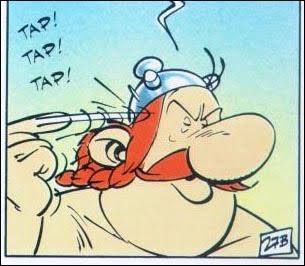
That's the joke.
The blacksmith and the fish seller are always at each other's throats. Chief Vitalstatistix is always nagged by his wife. A pretty Gaulish lady is always asking Obelix or Asterix out (and they blush), etc.
It takes an external threat to get these Gauls to stop fighting each other (which is the other joke, I guess). If those Romans just waited 10 minutes, the Gauls would've bashed each other's heads in, and the Romans could've waltzed in unopposed.
Those Romans are crazy!
The blacksmith and the fish seller are always at each other's throats. Chief Vitalstatistix is always nagged by his wife. A pretty Gaulish lady is always asking Obelix or Asterix out (and they blush), etc.
It takes an external threat to get these Gauls to stop fighting each other (which is the other joke, I guess). If those Romans just waited 10 minutes, the Gauls would've bashed each other's heads in, and the Romans could've waltzed in unopposed.
Those Romans are crazy!
I prefer stories where Asterix and Obelix travel, usually on a quest. One of my favourites that actually has some serious stakes is The Cauldron, where Asterix is exiled for failing to protect another Gaulish chieftan's money from being stolen (said chieftan was hiding it from the Roman taxman), and is forced to seek out money to repay said chieftan. There, Asterix's exile is treated with due gravitas, and Obelix joins him to help him in one of his better moments.
The twist is that the chieftan actually arranged for his money to be stolen back and given to the taxman. That way, not only did he stay on good terms with the Romans, but he could have Asterix pay him back the money (as Asterix points out, the chieftan wanted Asterix to pay said chieftan's taxes, showing that tax evasion of some stripe or another is as old as taxes). Asterix cottoned onto it when he noticed the money he took from the taxman smelled of the same onion soup the cauldron originally had in it, and realised it was the same money hoard.
Others of the travelogue type I love was Asterix in Switzerland (especially as, for a change, they're actually trying to save a Roman, albeit a principled one, from being poisoned by a corrupt and hedonistic Roman official who is embezzling taxes meant for Rome), Asterix in Britain (containing a joke in the English version about 'old fruit' that Rene Goscinny wish he'd thought of), and The Chieftan's Shield (which offers nuance to Vitalstatistix's backstory, even if it messes up continuity something fierce).
Allegedly, according to Wikipedia's article on Obelix (though no source is cited, frustratingly), "These Romans are crazy" is apparently a riff on Julius Caesar saying "These Gauls are crazy" in one of his writings. As no source is cited and a quick Google search turned up little, I've no idea, and I'm not trawling through Julius' writings to learn where he said that...
At times, it's a bad joke.
I prefer stories where Asterix and Obelix travel, usually on a quest. One of my favourites that actually has some serious stakes is The Cauldron, where Asterix is exiled for failing to protect another Gaulish chieftan's money from being stolen (said chieftan was hiding it from the Roman taxman), and is forced to seek out money to repay said chieftan. There, Asterix's exile is treated with due gravitas, and Obelix joins him to help him in one of his better moments.
The twist is that the chieftan actually arranged for his money to be stolen back and given to the taxman. That way, not only did he stay on good terms with the Romans, but he could have Asterix pay him back the money (as Asterix points out, the chieftan wanted Asterix to pay said chieftan's taxes, showing that tax evasion of some stripe or another is as old as taxes). Asterix cottoned onto it when he noticed the money he took from the taxman smelled of the same onion soup the cauldron originally had in it, and realised it was the same money hoard.
Others of the travelogue type I love was Asterix in Switzerland (especially as, for a change, they're actually trying to save a Roman, albeit a principled one, from being poisoned by a corrupt and hedonistic Roman official who is embezzling taxes meant for Rome), Asterix in Britain (containing a joke in the English version about 'old fruit' that Rene Goscinny wish he'd thought of), and The Chieftan's Shield (which offers nuance to Vitalstatistix's backstory, even if it messes up continuity something fierce).
The twist is that the chieftan actually arranged for his money to be stolen back and given to the taxman. That way, not only did he stay on good terms with the Romans, but he could have Asterix pay him back the money (as Asterix points out, the chieftan wanted Asterix to pay said chieftan's taxes, showing that tax evasion of some stripe or another is as old as taxes). Asterix cottoned onto it when he noticed the money he took from the taxman smelled of the same onion soup the cauldron originally had in it, and realised it was the same money hoard.
Others of the travelogue type I love was Asterix in Switzerland (especially as, for a change, they're actually trying to save a Roman, albeit a principled one, from being poisoned by a corrupt and hedonistic Roman official who is embezzling taxes meant for Rome), Asterix in Britain (containing a joke in the English version about 'old fruit' that Rene Goscinny wish he'd thought of), and The Chieftan's Shield (which offers nuance to Vitalstatistix's backstory, even if it messes up continuity something fierce).
On the other hand, Asterix travelling to Germania and Belgium is certainly much more fun.
Allegedly, according to Wikipedia's article on Obelix (though no source is cited, frustratingly), "These Romans are crazy" is apparently a riff on Julius Caesar saying "These Gauls are crazy" in one of his writings. As no source is cited and a quick Google search turned up little, I've no idea, and I'm not trawling through Julius' writings to learn where he said that...
He only says it in the Asterix comics - it's playfully attributed to him as a fictional reaction to fighting the stubborn village.
Well, anyway, some Asterix books have stood the test of time, for both personal taste and cultural reasons, and others have not.
Anyway, I just read through three more volumes of Elden Ring: The Road to the Erdtree, a parody manga of the Soulsborne game Elden Ring. It honestly wouldn't appeal to anyone not a Soulsborne fan, let alone an Elden Ring fan, and the humour can be cringy at times, but it's also beginning to feel like the story is coming into its own.
I've also started reading The Lightning Thief. It's not bad, but I do get the impression it's a touch overhyped, and there's not quite as much a sense of wonder as the Harry Potter books. The main part I like about it is that Rick Riordan basically made up the story for his son, who, like Percy Jackson, suffered from ADHD and dyslexia. I mean, that's pretty damn touching...
Anyway, I just read through three more volumes of Elden Ring: The Road to the Erdtree, a parody manga of the Soulsborne game Elden Ring. It honestly wouldn't appeal to anyone not a Soulsborne fan, let alone an Elden Ring fan, and the humour can be cringy at times, but it's also beginning to feel like the story is coming into its own.
I've also started reading The Lightning Thief. It's not bad, but I do get the impression it's a touch overhyped, and there's not quite as much a sense of wonder as the Harry Potter books. The main part I like about it is that Rick Riordan basically made up the story for his son, who, like Percy Jackson, suffered from ADHD and dyslexia. I mean, that's pretty damn touching...
Likes:
=Tamar
I'm still slogging through Sex with Presidents, which - despite the title - much more acts as mini-biographies of the presidents, their wives, their mistresses, and how it affected everyone around them.
It's honestly very good. I just finished reading the chapter on FDR and Eleanor Roosevelt -- I knew a little about her career in the White House but nothing about her early life -- and it's heartbreaking. From the little I've read of her, it seems possible (perhaps?) that she was somewhere on the autism spectrum disorder (ASD) level 1 (which used to be called Asperger's Syndrome).
Eleanor was bullied and belittled all of her early life, because she wasn't classically beautiful. She was smart, but described herself as almost pathologically shy and very sensitive. Because of her upbringing, she was very introverted. Being married to FDR, with his multiple infidelities, almost crushed her. But she overcame these and achieved many things, and also found love.
I won't go into details (that's what the book is about), but I recommend it. It can be a hard read, but a good one.
It's honestly very good. I just finished reading the chapter on FDR and Eleanor Roosevelt -- I knew a little about her career in the White House but nothing about her early life -- and it's heartbreaking. From the little I've read of her, it seems possible (perhaps?) that she was somewhere on the autism spectrum disorder (ASD) level 1 (which used to be called Asperger's Syndrome).
Eleanor was bullied and belittled all of her early life, because she wasn't classically beautiful. She was smart, but described herself as almost pathologically shy and very sensitive. Because of her upbringing, she was very introverted. Being married to FDR, with his multiple infidelities, almost crushed her. But she overcame these and achieved many things, and also found love.
I won't go into details (that's what the book is about), but I recommend it. It can be a hard read, but a good one.
Likes:
=Tamar
Ouch. Poor Eleanor Roosevelt.
And it still IS Asperger's, DSM-V be damned.
Meanwhile, I've finished The Lightning Thief. It was...okay, that's about as much as I can say. Not quite sure why the Percy Jackson franchise is so ridiculously popular, but it was an enjoyable enough romp. For all JK Rowling's faults, I think she was better at bringing about a sense of wonder to the Potterverse, to say nothing of worldbuilding...
And it still IS Asperger's, DSM-V be damned.
Meanwhile, I've finished The Lightning Thief. It was...okay, that's about as much as I can say. Not quite sure why the Percy Jackson franchise is so ridiculously popular, but it was an enjoyable enough romp. For all JK Rowling's faults, I think she was better at bringing about a sense of wonder to the Potterverse, to say nothing of worldbuilding...
Likes:
=Tamar
I've never read The Lightning Thief. It's aimed at 12-year-old boys (note how Percy is 12 years old -- that can give you a pretty big clue at who the audience is!) You're much better read than a 12-year-old, so that's probably why you didn't think it was "ZOMG!! This is like the best thing ever!" and so on.
12-year-olds are not the most discriminating critics ... but they're also very good at nagging their parents. "Please, dad? Pleeeease?" and so on.
I just finished reading the next chapter (about Eisenhower and his driver/aide/secretary, Kay Summersby ... full of things you'd never have believed -- poor Ike and Kay).
My current chapter concerns JFK, and is full of many things I definitely would believe. *ugh* One thing that caught my eye:
1. JFK had a thing for blond ladies;
2. His spin-doctors once told the press that more male voters will vote for virility, not fidelity;
3. One effect of the Addison's disease he suffered from gave him a permanent bronze tan (bordering on red or even orange);
4. He once bedded a 'burlesque icon' named Tempest Storm;
5. Etc., etc.
Remind you of anyone? Gee, must be a coincidence...
You're much better read than a 12-year-old, so that's probably why you didn't think it was "ZOMG!! This is like the best thing ever!" and so on.12-year-olds are not the most discriminating critics ... but they're also very good at nagging their parents. "Please, dad? Pleeeease?" and so on.
I just finished reading the next chapter (about Eisenhower and his driver/aide/secretary, Kay Summersby ... full of things you'd never have believed -- poor Ike and Kay).
My current chapter concerns JFK, and is full of many things I definitely would believe. *ugh* One thing that caught my eye:
1. JFK had a thing for blond ladies;
2. His spin-doctors once told the press that more male voters will vote for virility, not fidelity;
3. One effect of the Addison's disease he suffered from gave him a permanent bronze tan (bordering on red or even orange);
4. He once bedded a 'burlesque icon' named Tempest Storm;
5. Etc., etc.
Remind you of anyone? Gee, must be a coincidence...
I've never read The Lightning Thief. It's aimed at 12-year-old boys (note how Percy is 12 years old -- that can give you a pretty big clue at who the audience is!) You're much better read than a 12-year-old, so that's probably why you didn't think it was "ZOMG!! This is like the best thing ever!" and so on.
12-year-olds are not the most discriminating critics ... but they're also very good at nagging their parents. "Please, dad? Pleeeease?" and so on.
You're much better read than a 12-year-old, so that's probably why you didn't think it was "ZOMG!! This is like the best thing ever!" and so on.12-year-olds are not the most discriminating critics ... but they're also very good at nagging their parents. "Please, dad? Pleeeease?" and so on.
In addition, the plundering of Greco-Roman myth in fiction is overdone. While you can get some gems like God of War, or the Disney version of Hercules (as inaccurate as it is to the original myth), or how the Nasuverse treated the Greek pantheon (they're basically alien robots), other times...it comes across as cliched and hackneyed. One thing that aggravated me about the Amphoreus arc in Honkai Star Rail was that Amphoreus was basically a science fantasy version of every Greco-Roman clone society in fiction. Some of the worst Doctor Who stories from the classic series (The Time Monster, Underworld, The Horns of Nimon) tried to do their own take on Greek myth. And let's not forget The Hunger Games, originally partly inspired by the myth of the Minotaur and the Labyrinth...
Don't get me wrong, Rick Riordan did a decent job in integrating Greco-Roman myth into the modern day, as well as discussing the consequences of the various deities' many illegitimate children and how their parents react to that. But I also think he glossed over, for example, what Poseidon did to Medusa.
In the end, it was a decent romp, but I don't understand its following...though at least it's better than, say, Stephanie Meyer's output...
I just finished reading the next chapter (about Eisenhower and his driver/aide/secretary, Kay Summersby ... full of things you'd never have believed -- poor Ike and Kay).
My current chapter concerns JFK, and is full of many things I definitely would believe. *ugh* One thing that caught my eye:
1. JFK had a thing for blond ladies;
2. His spin-doctors once told the press that more male voters will vote for virility, not fidelity;
3. One effect of the Addison's disease he suffered from gave him a permanent bronze tan (bordering on red or even orange);
4. He once bedded a 'burlesque icon' named Tempest Storm;
5. Etc., etc.
Remind you of anyone? Gee, must be a coincidence...
My current chapter concerns JFK, and is full of many things I definitely would believe. *ugh* One thing that caught my eye:
1. JFK had a thing for blond ladies;
2. His spin-doctors once told the press that more male voters will vote for virility, not fidelity;
3. One effect of the Addison's disease he suffered from gave him a permanent bronze tan (bordering on red or even orange);
4. He once bedded a 'burlesque icon' named Tempest Storm;
5. Etc., etc.
Remind you of anyone? Gee, must be a coincidence...